
Civilizations we cannot see
Maybe Fermi's paradox is due to signs of advanced civilizations being "undetectable".


It was 1995 when humankind first found an extrasolar planet (exoplanet), called 51 Pegasi b, about 50 light-years away from our own star. It is a gas giant like Saturn, roughly half Jupiter’s mass, orbiting very close to its star (51 Pegasi, a G-type star in the middle of its main sequence, much like our Sun).
In 2009, NASA launched the spece telescope Kepler, whose mission was to find and analyze exoplanets surveying special regions of the sky where astronomers thought it was likely to find stars surrounded by planets. After monitoring more than 150,000 stars for a couple years, it actually was able to find some 2,600 exoplanets, among them the first Earth-like planet in 2011: Kepler-20e.
Today we know about more than 6,000 exoplanets in around 4,500 planetary systems, and those numbers are quickly rising: hundreds or even thousands of new exoplanets are discovered each year. The average distance between exoplanets and us is about 1k light-years, although the median distance is just around 600 light-years away from our Sun. Surprisingly, the closest exoplanet actually orbits the closest star after the Sun, and we call it Proxima Centauri b — just 4.25 light-years away.
The farthest exoplanet we know of is about 21,5k light-years away from us, and we gave it the cute name of OGLE-2005-BGL-390Lb: at this point we could call it anything, really. The thing is, some 20k light-years away from us is not that far in cosmic terms.
It’s not easy to find exoplanets, and for that we use very clever methods and high-tech equipment. And even doing that, we can’t look at very distant stars and be sure there are planets around them, although we actually can generalize based on the exoplanets we already did find and extrapolate an estimative of which kind of star harbors how many and whick kind of planets.
Around 2030 we probably will know about some 20,000 exoplanets “near” us, and dozens of them will be Earth-like on a good place to harbor life. And yet, we’ll find no trace of intelligent life among them, even if they were actually home to space-traveling civilizations.
Forever surrounded by darkness…
Using our current technology, if there were a “clone Earth” out there at maybe 500 light-years away from us, we wouldn’t be able to confidently tell the said planet harbors intelligent life, as we wouldn’t be able to detect signs of people living during the age of great navigations on a planet this far. A more distant “clone Earth” wouldn’t raise our awareness of people building pyramids and putting their Bronze Age empires to fight each other, at some 5k light-years away.
If our “clone Earth” lies about 50k light-years away, our best equipments and scientists wouldn’t have a clue about the very intelligent hunter-gatherers spreading through the globe, outcompeting their closest evolutionary cousins.We are simply unable to grasp enough details coming from a planet this far and make inferences that tell us, with high degrees of certainty, there are intelligent living beigns thriving at that floating stoneball.
Suppose our “clone Earth” is ahead of us in technology, and lies about 10k light-years away from us. In this scenario, the signs reaching us deliver a “Earth from 1900” to our equipments. At first you would guess it is quite easy to find a civilization from the very early 20th century, but this is not the case.
We can’t actually “see” a small, rocky planet this far, and even if we could, we wouldn’t be able to have pictures of their Eiffel Tower. Even if we were lucky enough to receive plenty of good data to analyze its atmospheric composition through spectroscopy, we would be able to tell this planet could sustain life, but no one on our Earth would be able to confidently tell they have some steel ships burning coal to travel their oceans.

“but radio waves…” you’d say on an eureka! moment, I guess. Oh, the good old radio communications, inadvertently spreading our “voice” through cosmic infinite reaches, echoing humankind’s old cries forever… Nah, you’d about to remember the “quadratic power low”, aren’t you? The energy density of a radio signal decreases with distance (of the source) squared, and a 10k light-years radius builds a HUGE sphere to “dilute” the energy: the radio signals emitted on 1900 are just too faint for us to detect in a meaningfull way at 10k light-years away.
Even a “clone Earth” from our early 21st century technology level wouldn’t be easy to find, if it lies 10k light-years away. Our communications evolved to be energetically efficient, and we are not emitting “supernova pulses” that we can’t produce anyways.
An intelligent species advanced enough to have colonies on other planets of their stellar system (like if we colonize Europe (Jupiter’s moon) or Mars) wouldn’t spend that much energy on communication, as they also would seek efficiency. We’d see, at most, very faint repetitive signals, and wonder what are their natural causes. And 10k light-years away from us are quite a neighbouring region.
An intelligent species inhabiting some random Andromeda’s star can enjoy space travels to distant moons and we wouldn’t have the faintest clue about it. And Andromeda is our closest large galaxy, quickly approaching us to merge with our own galaxy some billions of years in advance. More distant galaxies can harbor advanced intelligent life around millions of stars and we wouldn’t be able to tell if that’s the case.
The thing is, life is hard to find — even intelligent life! Only “supernova-like” or “quasar-like” pulse producing civilizations (that presumably hate energy efficiency, I guess) would be easier to find. And any life form that can artificially produce supernovae-like pulses (if that’s even possible) would not do that just to say “hello” to unknown civilizations many hundreds of thousands of light-years away from them.
The Universe can be full of advanced civilizations and we probably wouldn’t be able to tell, as we wouldn’t be able to grasp our own current (or past, or near future) civilization from a dozen thousands of light-years away — and we are the most advanced civilization we can actually be sure it is out there!
Dreaming of gods exploding stars!
Life is actually a low energy phenomenon, and as far as we can tell, it can not thrive in high energy environments, such G-type stars coronae, let alone G-type stars nuclei. Near a giant blue star or surrounding a type-IIb supernova, life is almost certainly impossible, and some hundreds of light-years from an active galactic nucleus, too.
Intelligent life is no different, and we can’t actually picture future generations living inside Earth’s mantle, let alone close to a quasar’s ejection jet. It’s true we harbor energy from the environment to do our tasks, but our energy requirements pale when compared to a Sun’s day emitting light.
Furthermore, useful energy is hard to get and control, thus the need of energy efficiency. We actually can send robots to explore Mars and probes to Pluto, and they did send signals towards the Earth (that’s why we make them, to begin with), but these pulses are not supernovae-like bursts, but faint, directed, modulated signals — smartly sent back to Earth in the most efficient way we know of.
Future aliens would need luck and very sensitive equipments in order to detect and make sense of New Horizon’s electromagnectic pulses 10k light-years away from the Oort Cloud, and an almost magical way to distinglish them from background noise.
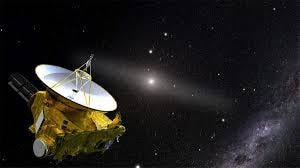
Even if in the future it gets common for us to travel between colonies in Europa, Enceladus, Titan and Mars, and automatic mining probes harvest minerals on the asteroid belt, we will certainly be very concerned about energy efficiency when designing our communication systems, and distant aliens wouldn’t be that luckier dealing with these signals than with Voyager’s.
Likewise, an alien civilization that already colonized some planets and moons on its planetary system would not produce quasar-like bursts in order to communicate. We most probably wouldn’t be able to properly detect their faint signals, and if we were lucky enough to do that, to make sense of them.
Even putative civilizations harvesting their star’s energy wouldn’t be that obvious to us — morover, we have a better guess of them being around by the fading starlight than by strong, wasteful very energetic bursts.
Therefore, even very advanced alien civilizations not that far from us, just some thousands of light-years away, wouldn’t let strong signatures we can easily detect and make sense of. As we also do not produce wasteful energy bursts to be seen thousands of light-years away — we actually can’t do it, and if (or when) we could, we probably wouldn’t do it anyways: it’s not that useful.
God-like creatures able to easily spend energy as if they were quasars are not a thing coming to our minds from a rational stance, but from fantastic novels that nurse excitement and awe on human minds. They’re nice tales, but not something that actually could exist.
We wouldn’t be able to actually tell our own Earth is home to an intelligent species able to harvest energy from atomic nuclei and send probes to the Oort Cloud if we were positioned a mere 500 light-years away. We look to the stars seeking for intelligent life signals we probably aren’t able to detect and make sense of.
That’s why the stars are silent and will be forever this way!